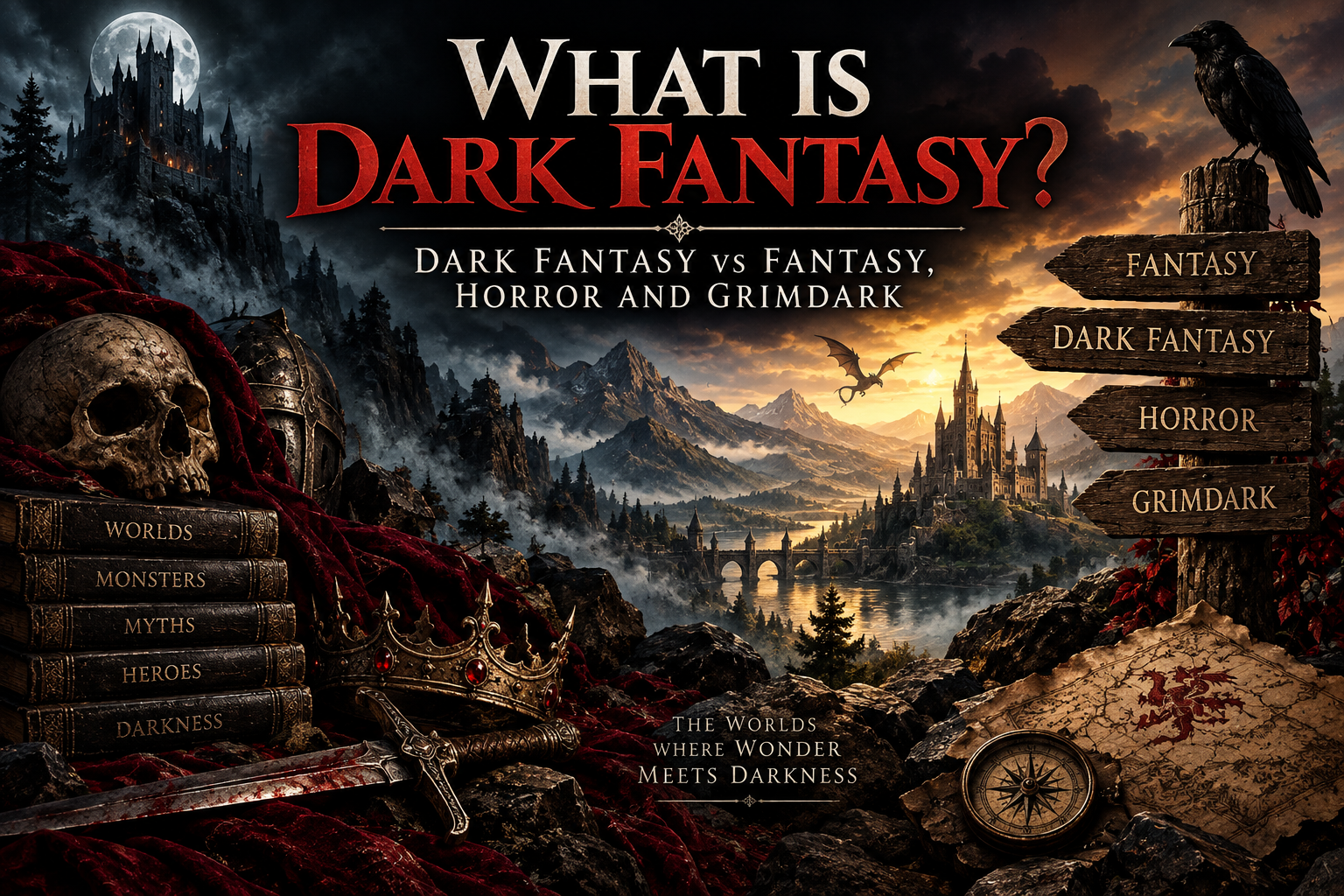
What Is Dark Fantasy? Dark Fantasy vs Fantasy, Horror and Grimdark
What Is Dark Fantasy?
Dark fantasy is where the impossible meets the disturbing.
It combines elements of fantasy — supernatural forces, imaginary worlds, magic, monsters or alternative realities — with the atmosphere, themes or emotional unease more commonly associated with horror.
But that simple definition only takes us so far.
What does dark fantasy really mean? How is dark fantasy different from ordinary fantasy? Is dark fantasy horror? And what is the difference between dark fantasy and grimdark?
Welcome to the darkness.
What Does Dark Fantasy Mean?
Dark fantasy is a broad genre combining fantastical or supernatural storytelling with darker themes, imagery, atmosphere or horror.
A dark fantasy story might contain:
- supernatural creatures
- vampires and other undead
- curses
- death and mortality
- moral corruption
- frightening mythology
- violence and warfare
- doomed or morally complicated characters
- Gothic settings
- religious or supernatural conflict
- ancient evil
- psychological horror
There is no rigid checklist.
That ambiguity is part of what makes dark fantasy interesting.
A novel can be unmistakably fantasy while borrowing the dread of horror. Another can essentially be a horror novel constructed upon extensive fantasy world-building.
Fantasy vs Dark Fantasy: What’s the Difference?
Traditional fantasy can certainly contain danger, death and frightening creatures.
What usually distinguishes dark fantasy from fantasy is the prominence of darkness within the atmosphere, themes and worldview.
In conventional heroic fantasy, evil may threaten the world but there is often a strong distinction between forces of good and evil.
Dark fantasy is frequently less comfortable.
Heroes can be compromised.
Victory can carry an appalling price.
The supernatural may be genuinely terrifying rather than wondrous.
Good people can make terrible decisions.
And sometimes the monster isn’t the worst thing in the room.
Is Dark Fantasy Horror?
Sometimes.
Dark fantasy and horror overlap considerably, but they are not synonymous.
Horror generally aims to frighten, disturb or unsettle its audience. Dark fantasy may do exactly that while simultaneously constructing the expansive mythology, alternative history or supernatural world associated with fantasy.
Imagine a spectrum rather than a border.
At one end lies fantasy with dark elements.
At the other lies outright supernatural horror.
Dark fantasy occupies the wonderfully uncomfortable territory between them.
What Is Horror Fantasy?
“Horror fantasy” and “dark fantasy” are sometimes used interchangeably, although the emphasis can differ.
Horror fantasy often describes a story in which horror is especially prominent but fantastical elements remain essential.
Dark fantasy may place greater emphasis on world-building, mythology and fantasy conventions while retaining an oppressive or disturbing tone.
Neither term has a universally enforced definition.
A medieval story about an underground vampire civilisation, for example, might reasonably be described as dark fantasy, vampire horror, Gothic fantasy and horror fantasy simultaneously.
Genre labels are tools for finding stories, not prison cells for keeping them in.
Dark Fantasy vs Grimdark
This distinction causes particular confusion.
Dark fantasy describes genre and atmosphere. Grimdark generally describes an especially bleak approach to morality, society and power.
Grimdark fiction commonly features cynical institutions, brutal worlds, compromised characters and few straightforward moral victories.
Dark fantasy doesn’t necessarily require that worldview.
A dark fantasy story can be frightening, violent and tragic while still containing courage, loyalty, love, sacrifice and genuine hope.
Likewise, grimdark fiction doesn’t necessarily need supernatural horror.
The two frequently overlap.
They aren’t the same thing.
Gothic Fantasy vs Dark Fantasy
Gothic fantasy is another close relative.
Gothic fiction traditionally favours atmosphere: castles, ruins, secrets, isolation, forbidden desires, inherited sins, supernatural dread and the intrusion of the past upon the present.
Dark fantasy is broader.
A Gothic fantasy novel may therefore also be dark fantasy, while a dark fantasy novel doesn’t need to be Gothic.
Put a vampire in a crumbling castle during a thunderstorm and the genres may start fighting over custody.
What Are Common Dark Fantasy Themes?
Some of the most powerful dark fantasy themes include:
Mortality — particularly what happens when characters attempt to escape it.
Corruption — of individuals, institutions, faith or power.
Revenge — and the price paid by those who pursue it.
Identity — especially the question of whether becoming monstrous makes someone a monster.
Power — who possesses it, who desires it and what they will sacrifice to retain it.
Faith and doubt — particularly in worlds where supernatural evil demonstrably exists.
Survival — and what morality means when survival itself is uncertain.
Forbidden love — where desire crosses social, political, religious or supernatural boundaries.
Fate versus choice — whether characters create their destinies or merely fulfil them.
These themes make dark fantasy particularly effective for stories where simple ideas of heroes and villains aren’t enough.
Is Dark Fantasy Demonic?
No.
Dark fantasy does not mean demonic fiction.
A dark fantasy story may contain demons, just as it may contain dragons, ghosts, vampires, witches or entirely original supernatural creatures.
The word “dark” describes the tone, themes and/or subject matter rather than prescribing a particular religious interpretation.
Did Dark Fantasy Always Exist?
Stories combining supernatural fantasy and horror existed long before publishers began using modern genre labels.
Myths, legends, medieval romances, Gothic literature and supernatural tales have always explored monsters, curses, death and terrifying forces beyond human understanding.
The label is relatively modern.
The instinct behind it is ancient.
Human beings have been telling frightening fantastical stories for as long as they have been telling stories at all.
Medieval Dark Fantasy
Few settings suit dark fantasy quite as naturally as the Middle Ages.
War.
Disease.
Religious conflict.
Dynastic violence.
Castles.
Forests.
Superstition.
Short lives and sudden deaths.
Now introduce the supernatural.
This is the territory explored in Antony J. Stanton’s Blood of the Dragon series, which combines medieval history, Gothic horror, vampire mythology and dark fantasy world-building.
Beginning with Blood of the Damned, the series imagines a hidden vampire underworld existing alongside humanity, with its own laws, rivalries, vengeance and conflicts.
It isn’t fantasy where darkness merely lurks at the edges.
The darkness has been there all along.
So, What Is Dark Fantasy?
Perhaps the simplest definition is this:
Dark fantasy is fantasy willing to enter the places where wonder becomes fear.
It takes the impossible and asks what happens when it isn’t beautiful.
When immortality is a curse.
When supernatural power corrupts.
When victory demands sacrifice.
When monsters aren’t necessarily the only monsters.
And when happily ever after was never promised.
Looking for Medieval Dark Fantasy?
Discover Antony J. Stanton’s Blood of the Damned, book one of the Blood of the Dragon series — a world of medieval warfare, vampire mythology, Gothic horror, vengeance and a hidden immortal society existing alongside humanity.