What Is Horror Fantasy? Where Horror and Fantasy Collide
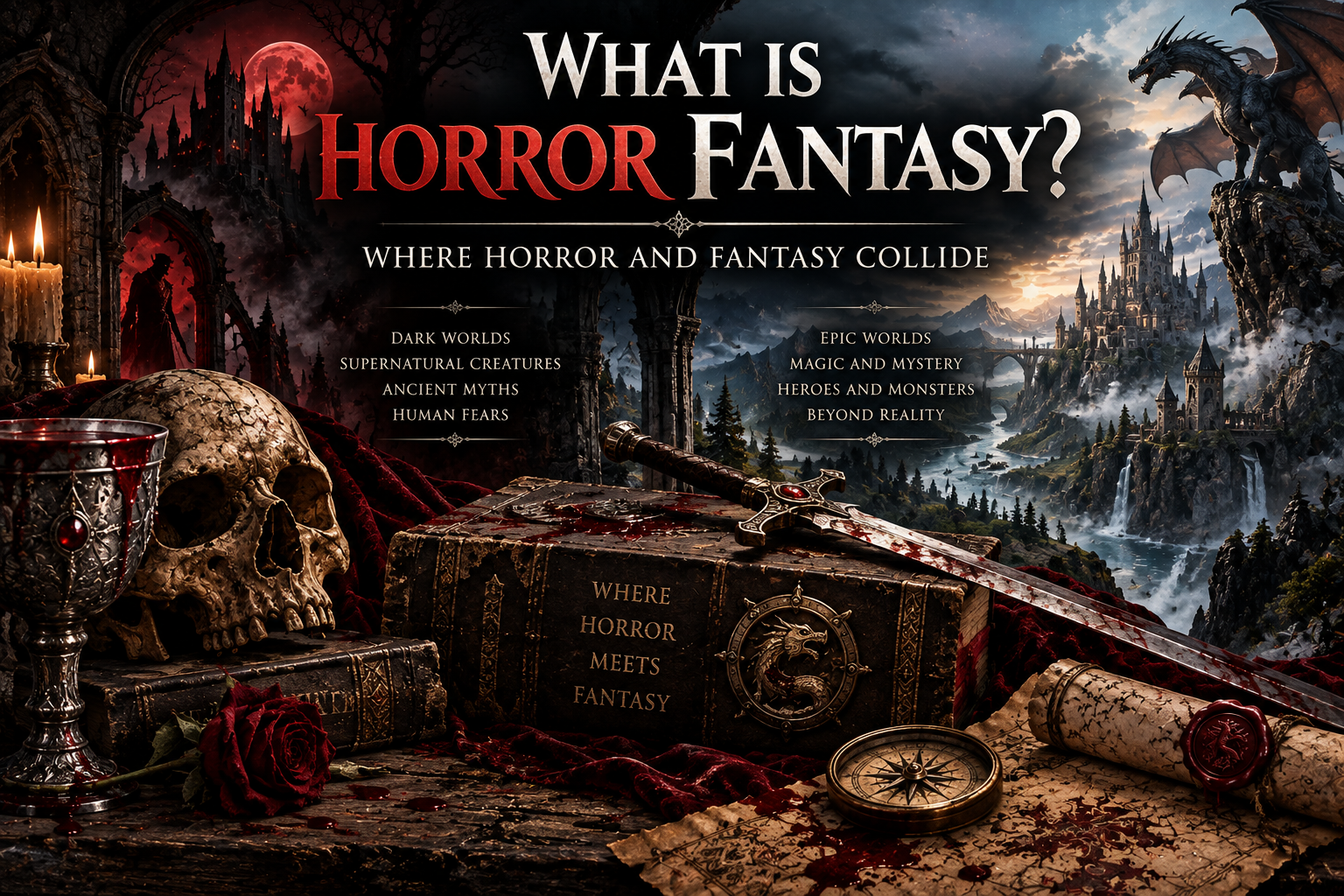
What Is Horror Fantasy?
A dragon can inspire wonder.
A vampire can inspire fear.
But what happens when the fantasy world itself becomes frightening?
Welcome to horror fantasy: the bloodstained territory where fantasy and horror meet.
What Is Horror Fantasy?
Horror fantasy is fiction that combines important elements of fantasy and horror.
The fantasy might come from an imaginary world, supernatural mythology, magic, invented creatures or an alternative version of history.
The horror comes from fear, dread, violence, monstrosity, psychological terror or the supernatural.
In the strongest horror fantasy, neither element feels added as decoration.
Remove the fantasy and the story collapses.
Remove the horror and it becomes something fundamentally different.
Fantasy Horror or Horror Fantasy?
You’ll see both phrases used.
There isn’t a universally accepted rule dividing fantasy horror from horror fantasy.
Readers and publishers may use either term depending upon which aspect of a story feels dominant.
A fantasy epic containing terrifying supernatural creatures might be described as fantasy horror.
A horror novel with extensive fantastical world-building might be called horror fantasy.
And many books comfortably belong to both.
Is Horror Fantasy the Same as Dark Fantasy?
Not quite.
There is considerable overlap between horror fantasy and dark fantasy, but the terms emphasise slightly different things.
Dark fantasy describes fantasy with dark, disturbing, macabre or horror-influenced themes and atmosphere.
Horror fantasy puts the horror component more explicitly at the heart of the description.
A story can therefore be both.
Indeed, vampire fiction is particularly good at refusing to remain within neat genre boundaries.
What Makes Fantasy Frightening?
Fantasy becomes horror when the supernatural stops being merely spectacular and starts becoming threatening.
Imagine discovering that vampires exist.
That’s fantasy.
Now imagine discovering that one has been following your family.
That’s horror.
Imagine an ancient society of immortals hidden alongside humanity.
Fantasy.
Now imagine those immortals manipulating wars, murdering rivals and regarding human beings as expendable.
The distinction becomes considerably less comfortable.
Gothic Horror in Fantasy
Gothic horror and fantasy are natural companions.
Gothic fiction thrives upon atmosphere and secrets: ancient buildings, forbidden places, inherited guilt, supernatural intrusion and the feeling that something terrible happened long ago and never truly ended.
Fantasy provides the freedom to make those fears real.
The castle really can be haunted.
The curse can be genuine.
The dead can return.
The monster whispered about in the village can actually be waiting in the forest.
High Fantasy Horror
Horror can also operate on an epic scale.
Rather than a haunted house or isolated village, high fantasy horror can threaten kingdoms, civilisations or entire worlds.
Large-scale world-building doesn’t make horror less effective.
Sometimes it makes it worse.
If one vampire is frightening, imagine an entire hidden civilisation of them.
Give them history.
Politics.
Religion.
Laws.
Rivalries.
Armies.
And grudges lasting centuries.
Suddenly the monster isn’t simply hunting a protagonist.
The monster has a society.
Why Vampires Work So Well in Horror Fantasy
Few creatures bridge fantasy and horror as successfully as the vampire.
A vampire is supernatural.
It defies death.
It can possess extraordinary abilities.
Those qualities belong comfortably within fantasy.
But the vampire survives by preying upon human beings.
It represents death invading life.
It transforms the familiar into something predatory.
Those qualities belong unmistakably to horror.
That is why vampire mythology has survived countless changes in literary fashion.
The vampire can evolve without surrendering the fear at its heart.
Medieval Horror Fantasy
Move horror fantasy into a medieval world and the possibilities multiply.
Imagine living without modern medicine, instant communication or scientific explanations for disease and death.
A traveller disappears.
Livestock die.
A family becomes mysteriously ill.
Someone claims to have seen a dead neighbour walking at night.
Is it superstition?
Disease?
Murder?
Or something considerably worse?
That uncertainty makes medieval history an extraordinarily powerful setting for supernatural horror.
When History Becomes Horror Fantasy
Antony J. Stanton’s Blood of the Dragon series inhabits this intersection between history, horror and fantasy.
Beginning with Blood of the Damned, it places vampire mythology within a brutal medieval landscape of warfare, family loyalty, vengeance and political intrigue.
The supernatural exists alongside recognisable human history.
Vampires aren’t simply creatures appearing when the plot requires a monster.
They possess their own hidden world.
Their own history.
And their own reasons for interfering with ours.
Horror and Fantasy Belong Together
Fantasy asks us to imagine that the impossible is real.
Horror asks us to consider what happens when we wish it wasn’t.
Put the two together and almost anything becomes possible.
Including the things we’d rather never meet.
Enter the Blood of the Dragon
If your preferred fantasy comes with Gothic atmosphere, medieval warfare, vampire mythology and considerably more blood, begin Antony J. Stanton’s Blood of the Dragon series with Blood of the Damned.
Or download the linked novella Speak of the Devil and enter the darkness for free.