The Ultimate Guide to Vampire Legends, Folklore, Dracula Mythology & the Origins of Vampires
Few monsters in human history have endured as powerfully as the vampire.
For centuries, tales of blood-drinking undead creatures have haunted civilizations across Europe, Asia, the Middle East, and beyond. Long before modern fiction transformed vampires into seductive immortals, ancient cultures feared them as horrifying revenants — cursed beings that rose from the grave to spread disease, death, madness, and terror.
Today, interest in vampire mythology is larger than ever. Readers search for:
- vampire mythology
- vampire legends
- origins of vampires
- ancient vampire myths
- vampire folklore
- Dracula mythology
- traditional vampires
Modern vampire fiction dominates books, films, television, gaming, and popular culture. Yet many fans know surprisingly little about the terrifying origins behind these legends.
This guide explores the complete history of vampire mythology — from ancient blood-drinking demons to medieval superstition, Gothic horror, Slavic folklore, Romanian legends, Vlad Dracula, Nosferatu myths, and the evolution of vampires in modern fiction.
If you want the definitive guide to vampire legends and traditional vampire folklore, this is it.
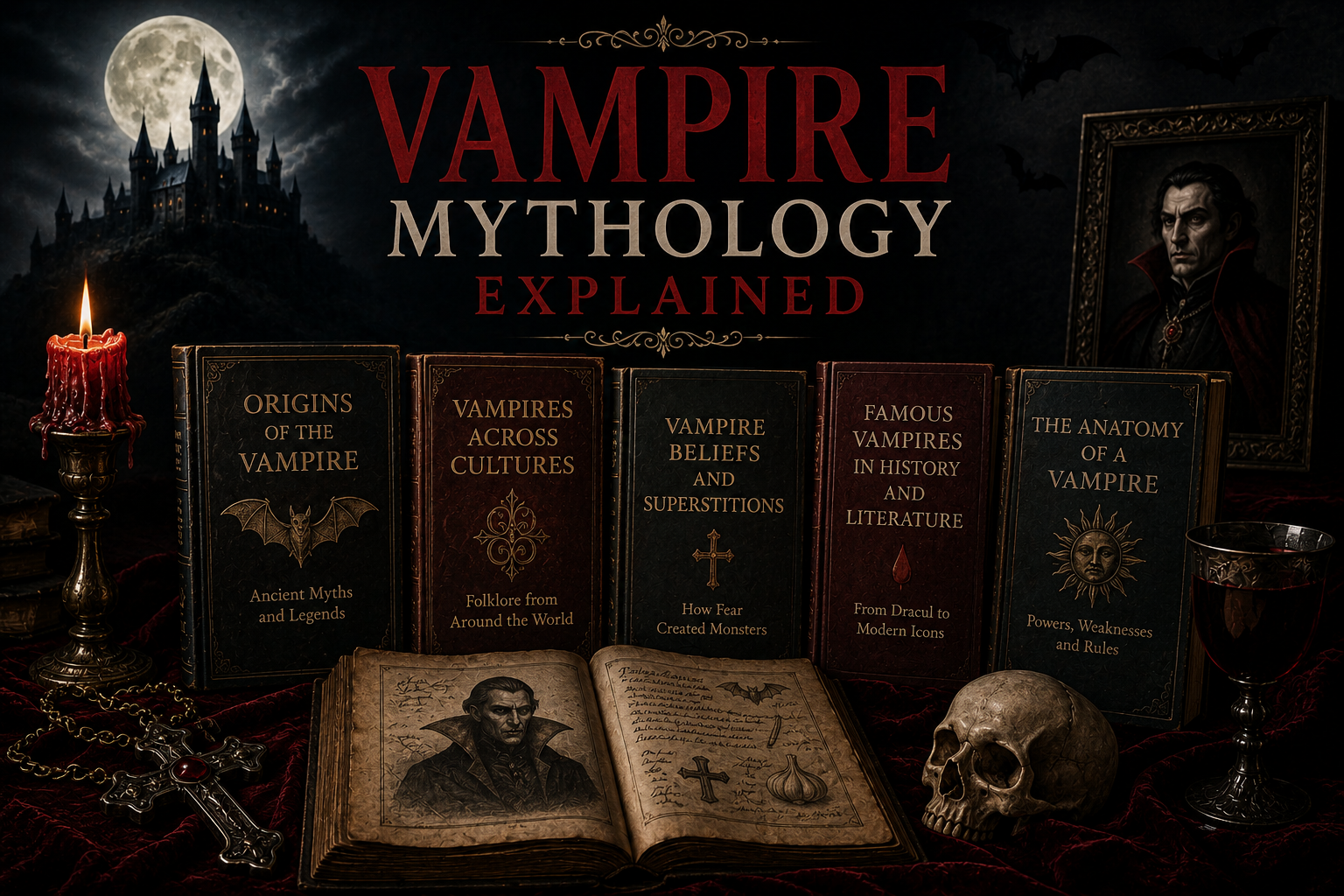
What Is Vampire Mythology?
At its core, vampire mythology refers to legends about undead creatures that survive by feeding on the living — usually through blood consumption.
However, the traditional vampire was vastly different from the modern romantic vampire seen in contemporary media.
In ancient folklore, vampires were often:
- Bloated corpses
- Rotting revenants
- Disease carriers
- Demonic entities
- Shape-shifting predators
- Supernatural parasites
- Cursed dead
They were feared not because they were attractive, but because they represented death itself.
Traditional vampire myths emerged from humanity’s deepest fears:
- plague
- disease
- premature burial
- unexplained death
- demonic possession
- religious damnation
- blood symbolism
- fear of the dead returning
Long before vampires became literary icons, they were deeply tied to real superstition.
The Origins of Vampires in Ancient Civilizations
Ancient Blood Myths and the Fear of Death
The origins of vampires can be traced thousands of years into ancient mythology.
Blood has always held symbolic importance in human culture. Ancient civilizations viewed blood as:
- the essence of life
- spiritual energy
- divine power
- sacrificial offering
- the seat of the soul
Because blood symbolized life, creatures that consumed blood naturally became associated with supernatural evil.
Many ancient myths featured entities resembling vampires long before the word “vampire” existed.
Ancient Mesopotamian Vampire Myths
Some of the earliest vampire-like legends emerged in Mesopotamia.
Ancient Babylonian and Assyrian mythology featured terrifying female demons that preyed upon humans.
Among them was Lilitu — believed by many historians to be an early predecessor to later vampire myths.
These entities were associated with:
- seduction
- blood consumption
- infant death
- disease
- night attacks
The fear of supernatural beings feeding on human vitality became deeply rooted in folklore.
These myths would later influence Jewish demonology and eventually European vampire traditions.
Ancient Greece and the Origins of Revenants
The ancient Greeks also feared undead spirits.
Several creatures from Greek mythology resembled vampires:
The Lamia
Lamia was a monstrous female figure who devoured children and seduced young men.
Over time, Lamia became associated with:
- blood-drinking
- seduction
- demonic femininity
- night hunting
The Empusa
Empusa was a shape-shifting demon that preyed upon travelers and consumed flesh and blood.
These ancient creatures established many themes later found in Gothic vampire fiction.
Ancient Roman Beliefs About the Dead
The Romans inherited many supernatural beliefs from Greece but added their own fears surrounding restless spirits.
Roman folklore included tales of:
- revenants
- blood-drinking spirits
- cursed corpses
- necromancy
Improper burial rites were believed capable of creating undead entities.
This idea became central to medieval vampire folklore.
Slavic Vampire Folklore
No region influenced vampire mythology more profoundly than Eastern Europe.
The Slavic peoples developed some of the most terrifying and detailed vampire legends in history.
This is where the traditional vampire truly emerged.
What Did Traditional Vampires Look Like?
Contrary to modern portrayals, traditional vampires were horrifying.
In Slavic folklore, vampires were often described as:
- swollen corpses
- red-faced bodies
- bloated stomachs
- blood around the mouth
- foul-smelling undead
- decomposing monsters
Rather than pale aristocrats, they resembled recently buried corpses swollen by decomposition.
Ironically, these natural post-mortem changes helped fuel vampire panic.
Villagers unfamiliar with decomposition believed these corpses appeared “alive.”
Why Did People Believe in Vampires?
During the medieval era, science was limited.
Communities struggled to explain:
- disease outbreaks
- sudden death
- plague
- tuberculosis
- miscarriages
- madness
- wasting illnesses
When multiple family members died in succession, people often blamed vampires.
The dead became scapegoats for tragedy.
Bodies were sometimes exhumed and examined for signs of vampirism.
If a corpse appeared unusually preserved, villagers believed it was undead.
The Vampire Panic of Eastern Europe
During the 17th and 18th centuries, Eastern Europe experienced genuine vampire hysteria.
Entire villages believed vampires were real.
Authorities documented cases involving:
- corpse mutilation
- exhumations
- stake executions
- decapitations
- corpse burnings
Historical records from Serbia and surrounding regions describe official investigations into suspected vampires.
These incidents helped spread vampire mythology throughout Europe.
Traditional Methods of Killing Vampires
Traditional vampire folklore included numerous ways to destroy the undead.
These methods varied by region but commonly included:
Wooden Stakes
Perhaps the most famous anti-vampire method.
A stake through the heart was believed to pin the vampire to the grave.
Decapitation
Removing the head prevented the corpse from rising again.
Burning the Body
Fire symbolized purification and complete destruction.
Garlic
Garlic became associated with protection due to its medicinal and spiritual symbolism.
Holy Symbols
Crosses, holy water, and religious rituals reflected Christianity’s influence on vampire mythology.
Romanian Vampire Legends
Romania became forever associated with vampires because of its connection to Vlad Dracula and Transylvanian folklore.
However, Romanian vampire legends existed long before Dracula.
The Strigoi
Romanian folklore includes terrifying undead creatures known as Strigoi.
These beings were believed to:
- rise from graves
- drain blood
- curse families
- spread disease
- torment villages
Strigoi could be living witches or undead revenants.
This duality made them especially feared.
Signs someone might become a Strigoi included:
- being born with a caul
- unusual physical traits
- sinful behavior
- improper burial
Romanian vampire folklore remains among the richest in Europe.
Vlad Dracula and Dracula Mythology
No historical figure is more connected to vampire mythology than Vlad the Impaler.
Also known as Vlad III Dracula, he ruled Wallachia during the 15th century.
His nickname “Dracula” derived from his father’s membership in the Order of the Dragon.
Was Vlad Dracula a Vampire?
Historically, no.
Vlad Dracula was not believed to be an actual vampire during his lifetime.
However, his terrifying reputation helped inspire later vampire mythology.
He became infamous for:
- impalement executions
- brutal warfare
- psychological terror
- mass killings
Stories exaggerated his cruelty until he became almost mythical.
Centuries later, Bram Stoker borrowed the name Dracula for his vampire count.
This permanently linked Vlad Dracula with vampire folklore.
Bram Stoker and the Birth of Modern Dracula Mythology
Published in 1897, Dracula transformed vampire mythology forever.
Stoker combined:
- Romanian folklore
- Gothic traditions
- Victorian fears
- medieval superstition
- aristocratic decadence
- supernatural horror
to create the definitive literary vampire.
Count Dracula differed greatly from traditional Slavic vampires.
He was:
- intelligent
- charismatic
- aristocratic
- manipulative
- seductive
- ancient
This version of the vampire became dominant in modern culture.
Gothic Traditions and Vampire Literature
The rise of Gothic literature deeply influenced vampire mythology.
Gothic fiction emphasized:
- crumbling castles
- darkness
- madness
- forbidden desire
- ancient curses
- supernatural terror
- tragic antiheroes
Vampires fit perfectly into this atmosphere.
The Gothic vampire became symbolic of:
- corruption
- immortality
- sexual fear
- aristocratic decay
- forbidden temptation
Nosferatu Myths and German Expressionism
One of the most important vampire adaptations was Nosferatu.
This silent German film presented Count Orlok as a horrifying plague-bearing monster.
Unlike romantic vampires, Orlok resembled traditional folklore creatures.
He was:
- rat-like
- corpse-like
- predatory
- monstrous
- disease-ridden
Nosferatu preserved the horror roots of vampire mythology.
Its visual style influenced horror cinema forever.
Medieval Superstition and the Fear of Vampires
The medieval world was deeply superstitious.
People believed evil forces constantly threatened humanity.
This environment helped vampire legends thrive.
Common medieval fears included:
- witchcraft
- demons
- possession
- divine punishment
- plague
- eternal damnation
The vampire embodied all these anxieties.
Disease and the Origins of Vampire Panic
Many historians believe vampire myths were linked to real diseases.
Tuberculosis
Tuberculosis caused victims to:
- become pale
- cough blood
- weaken slowly
Entire families could die sequentially.
Villagers believed deceased relatives were feeding on the living.
Rabies
Rabies influenced vampire folklore because sufferers exhibited:
- aggression
- biting behavior
- sensitivity to light
- aversion to water
These symptoms resembled later vampire characteristics.
Ancient Vampire Myths Around the World
Vampire-like creatures exist in many cultures.
China – Jiangshi
The Jiangshi is a hopping undead corpse that drains life energy.
India – Vetala
The Vetala inhabits corpses and feeds on humans.
Philippines – Aswang
The Aswang is a terrifying flesh-eating creature tied to vampire folklore.
Jewish Folklore – Lilith
Lilith became associated with seduction and child predation.
These myths demonstrate humanity’s universal fear of death and corruption.
Traditional Vampires vs Modern Vampires
One of the most fascinating aspects of vampire mythology is how dramatically vampires evolved.
Traditional Vampires
Traditional vampire folklore portrayed vampires as:
- grotesque
- demonic
- corpse-like
- unintelligent predators
- plague spreaders
- symbols of death
They represented terror and decay.
Modern Vampires
Modern fiction transformed vampires into:
- seductive immortals
- tragic antiheroes
- romantic figures
- powerful aristocrats
- misunderstood outsiders
This evolution accelerated during the 20th century.
Why Did Vampires Become Romantic?
Modern culture increasingly associated vampires with:
- immortality
- forbidden desire
- sexuality
- eternal youth
- rebellion
- power
The vampire evolved from monster into fantasy figure.
Works like Interview with the Vampire redefined vampires for modern audiences.
Vampire Symbolism Through History
Vampires have symbolized many human fears and desires.
Death
The vampire represents fear of mortality.
Disease
Vampires spread corruption and illness.
Sexuality
Victorian vampire fiction often reflected repressed desire.
Power
Immortality symbolizes domination and control.
Addiction
Blood-drinking resembles dependency and obsession.
Why Vampire Legends Continue to Fascinate Us
Vampires remain popular because they combine horror with immortality.
Unlike zombies or werewolves, vampires are intelligent.
They represent both:
- fear
- temptation
They are monsters — but also mirrors of humanity.
This complexity explains why vampire mythology survives across generations.
Medieval Vampire Mythology in Modern Fantasy
Modern fantasy increasingly returns to traditional vampire folklore.
Readers are growing interested in:
- medieval vampire horror
- Gothic fantasy
- historical vampire fiction
- dark fantasy horror
- traditional vampire mythology
This shift has inspired darker, more folklore-based vampire stories.
Blood of the Damned and Traditional Vampire Mythology
Modern medieval vampire fiction often draws heavily from traditional legends.
Blood of the Damned embraces many classic elements of vampire mythology, including:
- medieval superstition
- Gothic traditions
- ancient vampire lore
- brutal folklore-inspired vampires
- religious conflict
- dark historical atmosphere
Rather than presenting sanitized modern vampires, the novel reconnects the genre with its darker origins.
The story draws inspiration from:
- Eastern European folklore
- Dracula mythology
- medieval fears
- ancient blood myths
- Gothic horror traditions
making it particularly appealing for readers interested in traditional vampire legends.
The Future of Vampire Mythology
Vampire mythology continues evolving.
Modern audiences increasingly crave darker and more authentic vampire stories rooted in folklore and horror rather than romance alone.
As interest grows in:
- Gothic horror
- dark fantasy
- medieval fantasy
- folklore horror
- historical supernatural fiction
traditional vampire mythology is experiencing a major revival.
The ancient fear of the undead still resonates because it touches universal human anxieties:
- death
- corruption
- immortality
- temptation
- evil
- disease
- the unknown
The vampire survives because it constantly adapts to reflect the fears of each new generation.
Final Thoughts on Vampire Mythology
The history of vampire mythology is far older, darker, and more fascinating than many people realize.
From ancient Mesopotamian demons to Slavic revenants, Romanian Strigoi, Gothic aristocrats, and modern fantasy antiheroes, vampires have evolved continuously across centuries of storytelling.
Yet despite countless reinterpretations, the core fear remains unchanged:
The dead should stay dead.
That primal terror helped create one of the most enduring monsters in human history.
Whether encountered through ancient folklore, medieval superstition, Gothic literature, or modern dark fantasy, vampires continue haunting our imagination because they embody humanity’s oldest fears — and darkest desires.
For readers fascinated by:
- vampire folklore
- Dracula mythology
- traditional vampires
- ancient vampire myths
- medieval horror
- Gothic vampire fiction
the legends surrounding the undead remain as compelling today as they were centuries ago.