Everyone knows how to kill a vampire.
Sunlight. Garlic. A crucifix. A wooden stake through the heart.
Simple.
Except it isn’t.
Many of the vampire weaknesses we now accept as ancient folklore are surprisingly modern. Others really do have roots in traditional beliefs but have been changed dramatically by novels, theatre, film and television.
So what are vampires really afraid of?
Why are vampires supposedly afraid of garlic? Where did the wooden stake come from? Do crosses actually repel vampires? And perhaps most surprisingly of all, were vampires always killed by sunlight?
To answer those questions, we have to leave Hollywood behind and return to the graves, villages and superstitions from which vampire folklore emerged.
What Are Vampires Afraid Of?
There isn’t one definitive list of vampire weaknesses.
The vampire wasn’t created by a single author or culture. Beliefs concerning revenants, restless corpses and blood-drinking supernatural beings developed across different countries and centuries.
As a result, the answer to “what is a vampire afraid of?” depends entirely upon which vampire you’re talking about.
Traditional and fictional vampire weaknesses have included:
- wooden stakes
- decapitation
- burning
- garlic
- religious objects
- holy water
- sunlight
- running water
- mirrors
- particular plants
- sacred ground
- scattering seeds or grains
- preventing the corpse from leaving its grave
Some come from folklore.
Some were transformed by literature.
Others owe much of their popularity to cinema.
And a few things we think vampires fear weren’t necessarily intended to frighten them at all.
They were designed to make sure the dead stayed dead.
The Wooden Stake: One of the Oldest Vampire Weaknesses?
Few images are more closely associated with vampire hunting than a sharpened wooden stake.
In popular fiction, the instructions are straightforward: drive the stake through the vampire’s heart and the creature dies.
Traditional beliefs could be rather different.
In parts of European vampire folklore, suspected revenants were sometimes staked or otherwise physically restrained in their graves. The objective wasn’t necessarily to destroy the heart because it contained some supernatural source of vampiric power.
It could be much more practical.
Pin the corpse down so it cannot get back up.
Different traditions used different materials and methods. Folklore surrounding the restless dead varied enormously between communities, which is why attempts to produce one universal set of “vampire rules” are misleading.
The wooden stake nevertheless survived the journey from folklore into Gothic literature and popular culture.
Today it is probably the most famous vampire-killing weapon of them all.
Why Are Vampires Afraid of Garlic?
Garlic has protected fictional bedrooms from vampires for generations.
But why?
Garlic had associations with health, protection and the repelling of evil long before modern vampire fiction. In European folk traditions, garlic and other strongly scented plants could be regarded as protective against supernatural threats.
That made it an obvious addition to vampire lore.
The important distinction is that folklore doesn’t necessarily portray a vampire recoiling from garlic because it has a biological allergy to it.
Garlic is better understood as protective folklore.
It belongs to an old human tradition of using particular plants, objects and rituals to create a boundary between ourselves and things we fear.
Modern fiction turned that protection into something approaching supernatural vampire repellent.
It certainly makes shopping for a vampire considerably easier.
Are Vampires Afraid of Crosses?
The cross has become another universally recognised vampire weakness.
Hold up a crucifix and the vampire recoils.
Again, the history is more complicated.
European vampire beliefs developed in cultures where religion shaped understandings of life, death, burial and the supernatural. Religious objects, prayers, holy water and sacred rituals therefore became intertwined with beliefs concerning evil and the restless dead.
Bram Stoker’s Dracula reinforced the association between Christian symbols and protection from vampires for generations of readers.
Later films made the confrontation visually irresistible.
One person.
One approaching vampire.
One raised cross.
But even fiction disagrees about how this works.
Does the object itself possess supernatural power?
Does it depend upon the faith of the person holding it?
Does it affect every vampire?
Different authors have answered those questions differently.
There has never been a universally agreed vampire rulebook.
Does Holy Water Hurt Vampires?
Holy water belongs to the same tradition.
Modern vampire fiction often treats holy water almost like supernatural acid.
Folklore is less consistent.
Water blessed for religious purposes naturally became associated with protection against evil within Christian traditions, but the precise effects attributed to it vary considerably.
Literature, cinema and games subsequently turned an ambiguous supernatural protection into something with clearly defined rules.
That happens repeatedly in vampire mythology.
Folklore provides the idea.
Storytelling perfects the weapon.
Why Are Vampires Afraid of Sunlight?
This is perhaps the biggest surprise.
Ask someone today to name a vampire’s greatest weakness and they will probably answer:
Sunlight.
A vampire steps into daylight and bursts into flames or disintegrates.
Surely that must be one of the oldest vampire myths?
Not exactly.
Traditional vampire folklore does not contain a universal rule that sunlight instantly destroys vampires.
Even Bram Stoker’s Count Dracula is not simply reduced to ashes the moment sunlight touches him. Daylight limits his supernatural abilities, but it doesn’t operate like the lethal sunlight familiar from later vampire films.
Cinema played an enormous role in changing that.
The 1922 silent film Nosferatu famously made sunlight fatal to its vampire, Count Orlok.
It was an extraordinarily effective piece of visual storytelling.
Night belongs to the vampire.
Sunrise belongs to humanity.
Once that idea entered popular culture, it proved almost impossible to kill.
Ironically, sunlight became considerably more successful at destroying vampires than vampires were at surviving it.
Do Vampires Have Reflections?
A vampire approaches a mirror.
Nothing appears.
It’s another classic image.
The absence of a reflection is often explained through the idea that a vampire has no soul, although explanations vary enormously between traditions and fictional worlds.
Mirrors themselves possess a long history of supernatural symbolism. They have been associated with souls, death, truth, divination and gateways to other worlds.
Bram Stoker helped cement the missing reflection into modern vampire mythology when Jonathan Harker discovers that Dracula does not appear in his shaving mirror.
Modern fiction has since had to deal with an entertaining complication.
Old mirrors commonly contained silver.
Modern mirrors generally don’t work in quite the same way.
Does a vampire therefore appear on CCTV?
Can a vampire take a selfie?
Would Face ID recognise Dracula?
Folklore wasn’t required to answer these questions.
Modern vampire writers are not so fortunate.
Can Vampires Cross Running Water?
Another traditional belief sometimes associated with vampires is an inability or reluctance to cross running water.
Water frequently represents purification, boundaries and transitions in folklore.
Rivers are particularly powerful boundaries.
They divide one place from another and symbolically separate different states or worlds.
The rule varies greatly between vampire stories. Some vampires cannot cross running water at all. Others can cross under particular circumstances, while many modern vampires are entirely unconcerned by it.
Once again, there is no single correct version.
Do You Have to Invite a Vampire Into Your House?
“Don’t invite it in.”
It’s one of the most wonderfully unsettling vampire rules.
The creature may possess enormous supernatural power, yet apparently remains stranded on the doorstep until somebody makes a terrible mistake.
The idea of supernatural beings being restricted by thresholds and invitations is broader than vampire fiction itself. Doors and thresholds have long held symbolic importance in folklore because they represent boundaries between safety and danger, inside and outside, the familiar and the unknown.
Modern vampire stories turned this into an especially effective rule.
It also changes the nature of the horror.
The vampire cannot simply enter.
Someone has to let it in.
That creates an entirely different kind of danger — temptation, deception and misplaced trust.
Why Do Vampires Count Seeds?
This is one of the strangest vampire weaknesses — and one modern audiences may know less well.
Some European traditions surrounding vampires and other supernatural beings include an obsessive or compulsive need to count scattered objects.
Seeds, grains, poppy seeds or similar items could therefore be scattered near a grave or doorway.
The creature would supposedly become occupied counting them.
The idea sounds peculiar until you realise how widespread counting compulsions are in supernatural folklore.
And yes, this provides a rather wonderful historical connection to a certain famously number-obsessed Count from children’s television.
Sometimes folklore has a sense of humour even when it doesn’t intend to.
Can You Kill a Vampire by Decapitation?
Decapitation appears repeatedly in traditions concerning dangerous or restless corpses.
Again, the logic is difficult to fault.
If people feared that a corpse might physically rise from its grave, separating the head from the body provided a rather permanent obstacle.
Some traditions combined methods.
A suspected revenant might be staked, decapitated or burned, with the remains treated in ways intended to prevent its return.
This is an important reminder that historical vampire belief could be considerably more gruesome than modern romantic vampire fiction.
For communities that genuinely feared the returning dead, these weren’t cinematic monsters.
They were neighbours.
Relatives.
People they had buried.
Does Fire Kill Vampires?
Fire is one of humanity’s oldest methods of purification and destruction, so unsurprisingly it appears in beliefs surrounding dangerous supernatural creatures and corpses.
Burning suspected revenants or their remains could ensure that there was simply no intact body left to return.
Modern vampire fiction has retained fire as one of the more reliable methods of destruction.
Even extraordinarily powerful immortals tend to find being reduced to ash inconvenient.
What About Silver?
Silver is interesting because many people automatically associate it with vampires.
Yet silver is much more famously connected with werewolf mythology in modern popular culture.
Various supernatural traditions have attributed protective qualities to silver, and modern fiction frequently borrows weaknesses between different monsters.
Consequently, some fictional vampires are vulnerable to silver.
Others couldn’t care less.
If you’re facing an unidentified supernatural creature, however, carrying some probably isn’t the worst idea anyone has ever had.
Are Vampires Afraid of Churches and Sacred Ground?
Vampire fiction frequently portrays sacred places as inaccessible or dangerous to the undead.
The idea fits naturally with Christian interpretations of vampires as unnatural beings existing outside the proper order of life and death.
But, as with so many supposed vampire rules, traditions and fictional interpretations differ.
Some vampires cannot enter consecrated ground.
Others can enter but find it uncomfortable.
Some are harmed by religious objects.
Others are affected only when genuine faith lies behind them.
And some modern vampires wander into churches perfectly happily.
The rule tells us as much about the storyteller’s world as it does about the vampire.
Which Vampire Weaknesses Actually Come From Folklore?
This is where vampire mythology becomes especially interesting.
The vampire we recognise today is essentially a creature assembled over centuries.
Folklore contributed restless corpses, burial rituals, staking, decapitation, protective plants and numerous methods of preventing the dead from returning.
Religion contributed sacred symbols, holy water, burial traditions and ideas about the soul.
Gothic literature contributed aristocracy, seduction, castles, sophisticated supernatural rules and unforgettable characters.
Cinema contributed some of the vampire’s strongest visual conventions — particularly the destructive power of sunlight.
Later novels, television programmes, games and films continued rewriting the rules.
Every generation inherited the vampire.
And every generation changed it.
What Is a Vampire’s Greatest Weakness?
There is no definitive answer.
If we’re talking about modern popular culture, sunlight and a stake through the heart are probably the two most widely recognised vampire weaknesses.
If we’re talking about historical folklore, the question itself becomes more complicated.
People weren’t necessarily asking:
“What supernatural substance damages a vampire?”
They were asking:
“How do we stop the dead person we’ve buried from coming back?”
That difference matters.
It transforms the vampire from a fantasy monster with statistics and weaknesses into something far more unsettling.
A human corpse that refuses to remain dead.
Vampire Weaknesses in Modern Dark Fantasy
One of the pleasures of writing vampire fiction is deciding which rules survive.
Must vampires drink blood?
Can they walk in daylight?
Do crosses affect them?
Can they enter a house uninvited?
Does a stake kill them?
Are they truly immortal?
Every decision changes the world around them.
Make vampires completely invulnerable and it becomes difficult for humans to threaten them.
Make them vulnerable to everything in traditional folklore and an adequately prepared kitchen could become an armoury.
The most interesting vampire worlds therefore don’t simply ask what vampires are afraid of.
They ask why.
Vampire Folklore and Blood of the Dragon
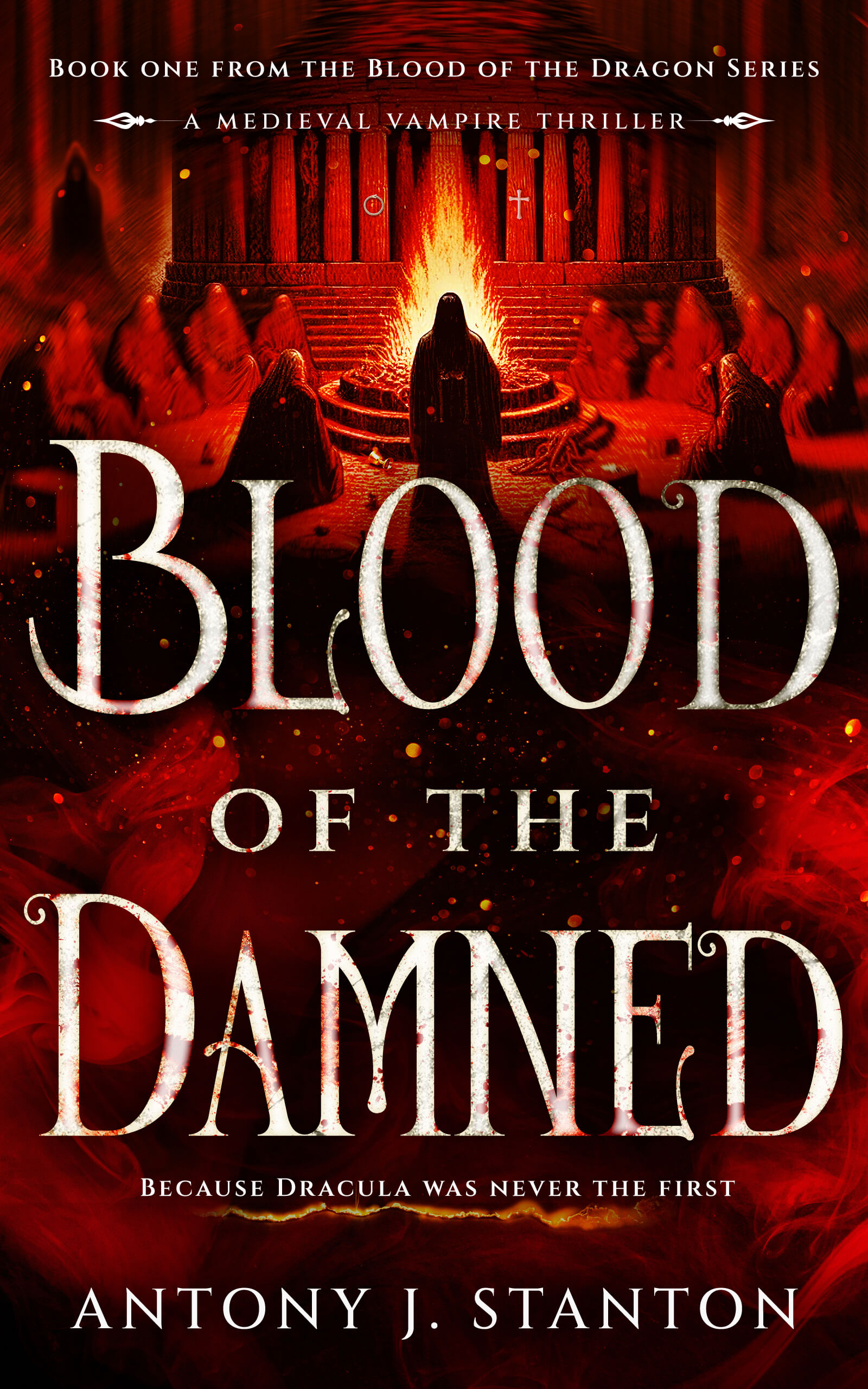
The Blood of the Dragon series draws upon the long history of vampire mythology while creating its own world of immortals, bloodlines, rivalries and ancient conflicts.
Beginning with Blood of the Damned, the series places vampires within a brutal medieval landscape where superstition and supernatural belief exist alongside warfare, religion, political ambition and vengeance.
That setting changes the meaning of vampire folklore.
Imagine living in a world where nobody can search for an explanation.
A body is discovered.
Someone swears they saw the dead walking.
Another person insists garlic will protect the house.
The priest has his explanation.
The physician has another.
And somewhere beyond the village, something really is moving through the darkness.
Which stories are superstition?
Which have changed during centuries of retelling?
And which warnings should people have listened to?
That’s where folklore becomes particularly dangerous.
In a world where vampires really exist, the myths don’t all have to be wrong.
Why Do Vampire Weaknesses Continue to Change?
Because the vampire changes with us.
It has represented disease, death, sexuality, aristocracy, outsiders, corruption, immortality, addiction, power and fear of the unknown.
The weaknesses change because writers continually ask new questions.
What happens if sunlight doesn’t kill a vampire?
What happens if religious symbols have no effect?
What if the vampire isn’t afraid of the cross — but remembers when it once believed in it?
What if immortality itself is the weakness?
That’s why vampire mythology remains so powerful.
There is no final version.
There never has been.
So, What Are Vampires Really Afraid Of?
The traditional answers include stakes, garlic, religious protections, decapitation and various methods intended to keep the restless dead in their graves.
Modern fiction added or strengthened other rules, most famously lethal sunlight.
But perhaps the most compelling vampire weakness isn’t a weapon at all.
A vampire survives while generations of human beings live and die around it.
Kingdoms disappear.
Languages change.
Families vanish.
Faith changes.
Enemies die.
Friends die.
Love dies.
The vampire doesn’t.
Immortality sounds like the ultimate supernatural power.
Until you have to live with it forever.
Enter the World of Blood of the Dragon
If you enjoy vampire folklore, medieval dark fantasy, Gothic horror and vampire mythology, enter the world of Antony J. Stanton’s Blood of the Dragon series.
Begin with Blood of the Damned, where medieval history and vampire mythology collide in a world of ancient bloodlines, warfare, vengeance and the immortal society hidden alongside humanity.
You can also enter Antony J. Stanton’s vampire world with Speak of the Devil — a linked novella available to readers through AntonyJStanton.com.
The old stories say you should fear the vampire.
Perhaps you should fear the stories that turned out to be true.
Written by : AJS

Subscribe To My Newsletter
For book news, sneak-peaks, give-aways, fascinating stories of vampires, dark fantasy and horror from around the world, as well as the FREE novella, "Speak of the Devil," sign up for all this and more.
Link up with other link-minded fans of the dark and macabre.
Come. Join us.