The vampire did not begin with Dracula.
Long before Bram Stoker sent a Transylvanian count to England, cultures across the world told stories about the dead returning to trouble the living. Some drank blood. Some consumed the life or vitality of their victims. Others spread disease, attacked sleeping families or simply refused to remain peacefully in their graves.
Yet there has never been one universal vampire.
Vampire folklore changes dramatically by region, and tracing those differences reveals something far more interesting than the familiar image of fangs, capes and coffins.
It reveals thousands of years of human fear.
Where Did Vampire Mythology Begin?
There is no single point at which historians can say, “Here is where the vampire was invented.”
Beliefs resembling later vampire legends developed independently in numerous cultures. Ancient peoples attempted to explain death, disease, decomposition and unexplained misfortune using the knowledge available to them.
That produced a remarkable collection of supernatural beings associated with blood, death and the night.
Not all of them should technically be described as vampires. Applying the modern word vampire to every ancient blood-drinking or death-associated creature can obscure important differences between cultures.
But some provide fascinating early parallels to the mythology that followed.
Mesopotamian Vampires and Ancient Blood-Drinking Spirits
Searches for Mesopotamian vampires often lead to some of the oldest supernatural traditions associated with predatory spirits.
Ancient Mesopotamian cultures told of dangerous supernatural beings connected with illness, death and attacks upon humans. Figures such as the Lamashtu and various restless spirits are sometimes compared with later vampires.
They were not vampires in the modern literary sense.
There were no aristocratic counts sleeping in coffins.
Nevertheless, the underlying fears are strikingly familiar: supernatural predators, attacks in darkness, danger surrounding death and the belief that malevolent entities could cross the boundary between the living and supernatural worlds.
That boundary would remain at the heart of vampire mythology for millennia.
Ancient Greece: The Dead Who Would Not Stay Dead
Greek mythology contributed another rich collection of creatures subsequently associated with vampire legends.
The Lamia became associated with the destruction of children and, in later traditions, with predatory female supernatural beings. The empusa was another terrifying figure linked with seduction and death.
Again, these were not simply early versions of Count Dracula.
But Greek traditions helped establish ideas that would become recurring features of vampire mythology: seduction, transformation, predation and supernatural beings feeding upon humans.
The Balkans and Slavic Vampire Folklore
For the vampire recognisable to modern readers, Eastern and Southeastern Europe are particularly important.
Vampire folklore became deeply embedded in the traditions of Slavic communities and the Balkans. Stories differed between regions and periods, but many involved the restless dead physically returning from their graves.
These were frequently far removed from the elegant vampires of Gothic literature.
The suspected revenant might be a recently deceased neighbour.
A family member.
Someone whose death, burial or behaviour had been considered unusual.
Disease or a succession of deaths within a community could intensify suspicions that one of the dead had returned to prey upon those left behind.
Methods believed to prevent or destroy such revenants included staking, decapitation, burning and other treatments of the corpse.
Here we begin to recognise the foundations of the vampire that would eventually enter Western literature.
Romania, Transylvania and the Strigoi
Romanian folklore contains traditions surrounding the strigoi, supernatural beings whose characteristics vary across different accounts and periods.
Some traditions distinguish between living and dead strigoi, while stories attribute an assortment of supernatural abilities to them.
Modern popular culture has inevitably linked Romanian vampire folklore with Transylvania and Vlad Dracula.
The reality is more complicated.
Vlad III of Wallachia — commonly known as Vlad the Impaler — was a historical ruler rather than a supernatural vampire. Bram Stoker later borrowed the name Dracula for his fictional count, helping permanently fuse Romanian history, Transylvania and vampire fiction in the popular imagination.
The result is one of literature’s most enduring mixtures of history and myth.
Serbia and the Vampire
Serbia occupies an important place in the history of European vampire belief.
During the eighteenth century, reported vampire cases in Eastern Europe attracted considerable attention elsewhere on the continent. Accounts of supposed revenants helped bring the concept — and eventually the word vampire — into wider Western European discussion.
The vampire was moving from village folklore towards international phenomenon.
Soon, literature would take over.
Britain and the Rise of the Gothic Vampire
Britain did not invent vampire folklore, but British and Irish writers played an enormous role in transforming it into the literary vampire recognised today.
John Polidori’s The Vampyre helped popularise the sophisticated aristocratic vampire in the nineteenth century.
Sheridan Le Fanu’s Carmilla gave readers one of literature’s most influential female vampires.
Then, in 1897, Bram Stoker published Dracula.
The vampire had changed.
The bloated or recently deceased revenant feared by rural communities had evolved into something intelligent, ancient and terrifyingly charismatic.
Folklore had become Gothic horror.
Why Are Vampires Afraid of Sunlight?
One of the most interesting things about vampire mythology is how much of what we now consider “traditional” is actually comparatively modern.
Take sunlight.
The idea that sunlight immediately destroys vampires is not a universal feature of old vampire folklore, nor is it treated in exactly the same way throughout classic vampire literature.
Modern vampire weaknesses are an accumulation of folklore, religion, literature, theatre and cinema.
That is why asking “what is a vampire afraid of?” has no single answer.
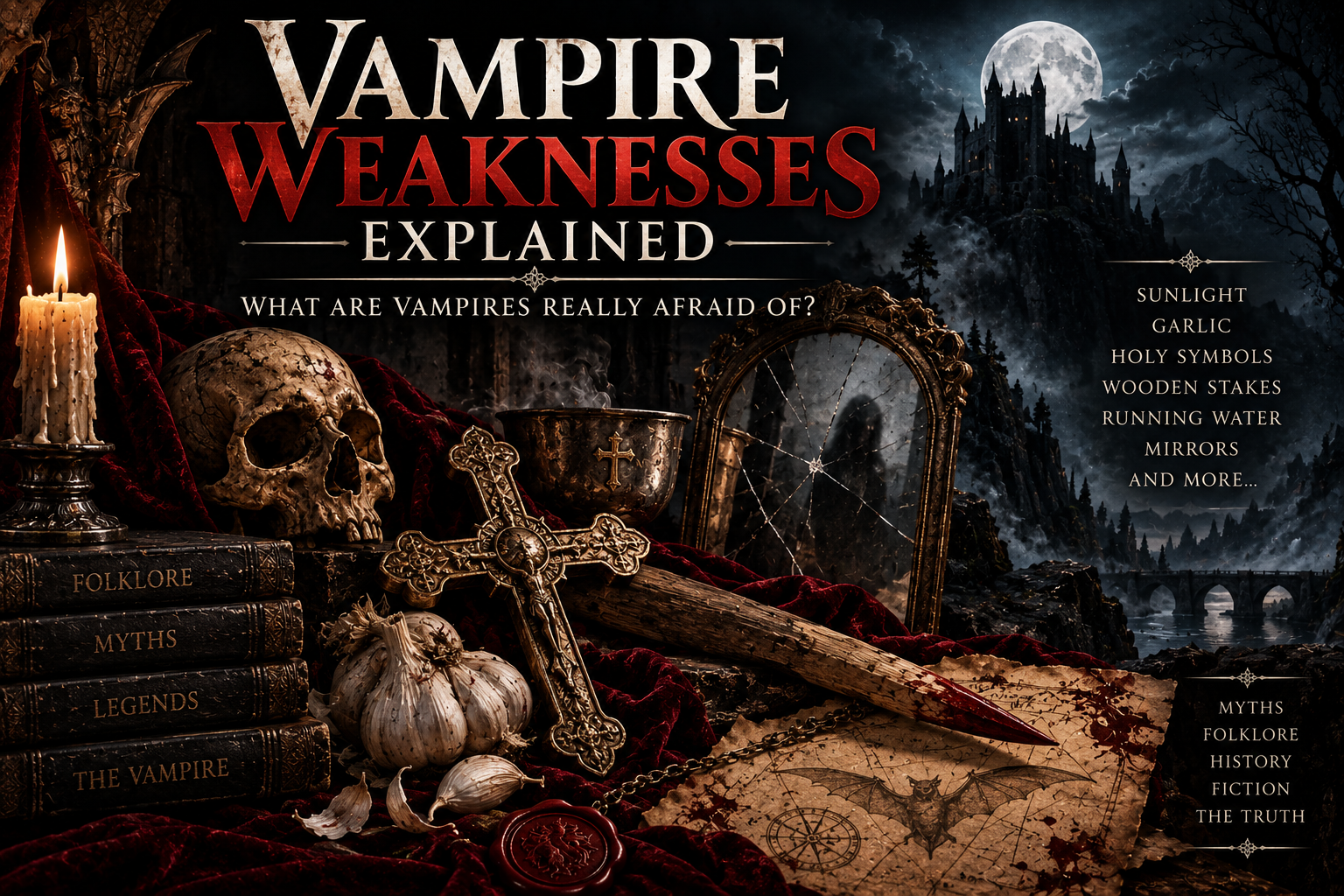
Depending upon the tradition, supposed protections against vampires have included:
- religious objects
- garlic
- particular plants
- stakes
- decapitation
- fire
- sacred ground
- sunlight
- running water
The rules change because vampire mythology has always changed.
Vampire Symbols and Their Meanings
Certain symbols have become inseparable from vampire fiction.
Blood represents life, death, inheritance, desire and corruption.
The night represents vulnerability and the unknown.
The grave represents the violation of the boundary between life and death.
Religious symbols can represent faith, protection and the conflict between sacred and profane.
The castle represents isolation, antiquity and hidden power.
And immortality, perhaps the most important symbol of all, is both gift and curse.
The vampire survives death — but must live with what survival requires.
From Folklore to Modern Dark Fantasy
Modern vampire fiction has inherited thousands of years of myths without being constrained by them.
Authors can take elements from folklore and ask new questions.
What if vampires possessed their own history?
Their own laws?
Their own rivalries?
What if they had existed beside humanity throughout wars, crusades and dynastic struggles?
And what if the history humans remember were only part of the story?
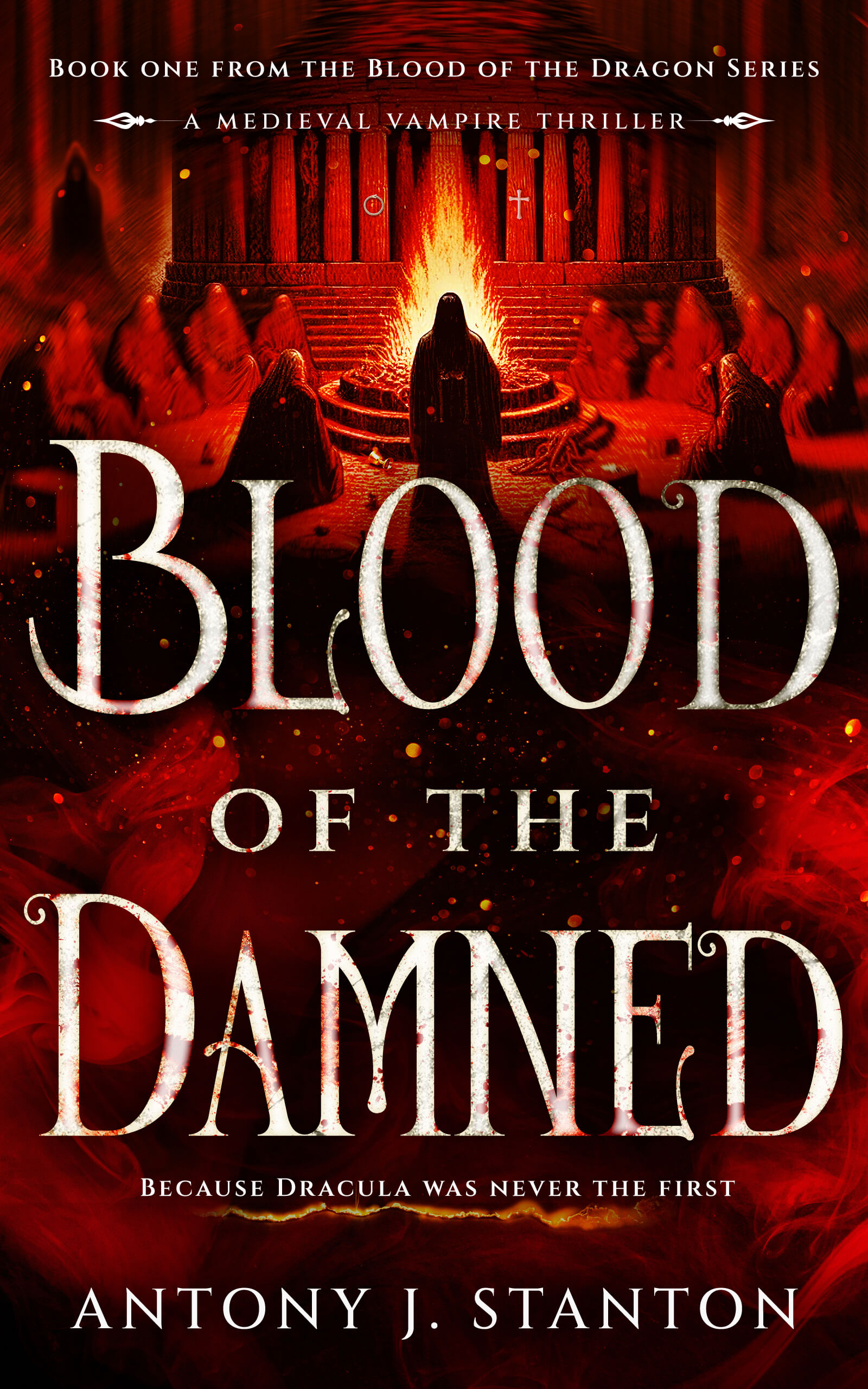
Those questions sit at the heart of Antony J. Stanton’s Blood of the Dragon series, beginning with Blood of the Damned.
Set against a brutal medieval world, the series returns the vampire to an age in which superstition, religion, warfare and fear of the unknown could be matters of life and death — while creating a hidden vampire society with its own conflicts, vendettas and history.
Why Vampire Folklore Still Fascinates Us
Every generation reinvents the vampire.
It has been corpse, demon, aristocrat, seducer, monster, romantic hero, plague carrier, warrior and antihero.
Perhaps that adaptability explains why vampire legends refuse to die.
Behind almost every version lies the same disturbing idea:
What if death isn’t the end?
And perhaps the more frightening question:
What if something comes back?
Enter a Darker Vampire World
If you enjoy vampire folklore, Gothic horror, medieval history and dark fantasy, discover Blood of the Damned, the first novel in Antony J. Stanton’s Blood of the Dragon series.
Or enter the world for free with the linked novella, Speak of the Devil.
Written by : AJS

Subscribe To My Newsletter
For book news, sneak-peaks, give-aways, fascinating stories of vampires, dark fantasy and horror from around the world, as well as the FREE novella, "Speak of the Devil," sign up for all this and more.
Link up with other link-minded fans of the dark and macabre.
Come. Join us.